Chungliyimti Nung Tzü Külemba [Upon the Mount of Chungliyimti]
Poetry
.
0:31
Title: Chungliyimti Nung Tzü Külemba [Upon the Mount of Chungliyimti]
Language: Ao
Narrator: Dr. Sentinaro (Asst. Professor, Department of English, Baptist College, Kohima)
State: Nagaland
Original (Ao Naga)
Oh Chungliyimti kong nung, mongdang ayimer,
Arüng salangpang nung netsüng temang sendenangni
Netsüng temang sendener, Tsüngrem kümer,
Ongangla dang jagi, Amtok- Amsü oani ,
Tzüsen tzübo külemangta,
Tzüsen tzübo külemteta yur
Orong saku agi yimrong süngsang tutengoni
Translated version (English) :
“Upon the Mount of Chungliyimti.”
Oh, upon the mount of Chungliyimti,
A summons to convention was proclaimed.
Let all subjects gather by the cane platform;
’Twas resolved to seek Ongangla,*
To foretell the days yet to come.
She spoke: “Worship the Tzusen Tzubo.”**
Having consecrated the sacred pond,
March forth to assail the land of Orong.
Return triumphant, and erect an edifice
Crowned with the heads of the fallen.”
*Ongangla: A sorceress in Ao Folklore
** Tzusen Tzubo: A sacred pond at Chungliyimti
Contextual Note:
In the Ao Naga tradition, songs are not merely musical expressions but also literary forms that
encode history, memory, and cultural values. Their use of imagery, metaphor, and rhythmic
structure aligns them with the qualities of poetry. While composed for oral performance, such songs
function as mnemonic devices, aesthetic creations, and repositories of collective knowledge.
Interpreting them as poems in a contemporary context does not diminish their musical dimension
but rather acknowledges their dual role as both lyrical art and cultural text. Thus, the song from
Chungliyimti may also be read as a poem, reflecting the broader understanding within Ao society
where song and poetry converge as inseparable forms of expression.
The poem in song talks of Chungliyimti village which holds a foundational place in Ao Naga
history as the first village of the Aos, believed to be the site where their earliest ancestors settled.
Oral traditions recall it as a sacred space of beginnings, where rituals, prophecies, and decisions of
collective destiny were made. The reference to Ongangla, the witch, and the Tzusen tzubo (a sacred
pond) reflects the intertwining of myth, spirituality, and community life in the Ao cultural memory.
References to warfare, ritual victory, and the construction of edifices with enemy heads further
underscore the ways in which memory, myth, and martial practice were integrated into the
formation of communal identity.
*Taken from Kongshir Ken, by Sademmeren Longkumer, 2007.
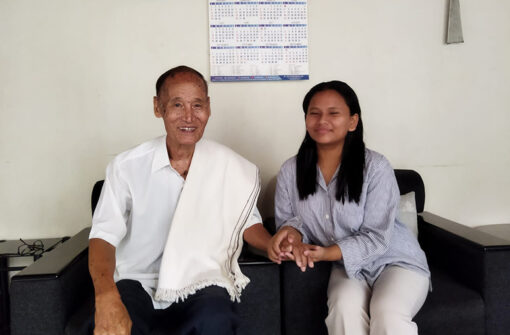
Dr. Sademmeren Longkümer (1927-2020)worked as a teacher in his native village Ungma since
1947 and subsequently retired in 1985. He is a recipient of the Governor’s Award in the field of Art,
Literature, Folklore and Drama; the Sangeet Natak Academy Rabindranath Tagore Puraskar award;
and was conferred the title Guru under Gurushishya Parampara by NEZCC, Govt. of India. Besides,
he was also nominated as an Honorary Associate Member of CIOFF, Sweden, and was awarded
Honorary Doctorate from National Virtual University for Peace and Education in Association with
SS Academy; Registered with United Nations Organization.
Translated by: Dr. Sentinaro
A researcher and academic teaching at Baptist College, Kohima, Nagaland University as an
Assistant Professor in the Department of English. She has to her credit academic and research
papers on her area of interest, which include Naga writings in English, cultural studies, comparative
literature, oral tradition, marginalised/subaltern literature, postcolonial studies, interdisciplinary
studies etc. A sometimes writer of articles, book blurbs and foreword. Delivered talk and moderated
a panel discussion on “Folklore and Indigenous Fantasy,” in the Nagaland Literature Fest 2022& 2023. She is the co-author of Insider Perspective: Critical Essays on Literature from Nagaland, co-
editor of Sharing Stories, Discourses on Cultural Heritage in Contemporary Nagaland, Homegrown
Anthology of New Writings from Nagaland and has contributed a chapter in Northeast India:
Readings in Cultural Life and in Dialectics On North East Writings: Theory and Praxis. She has
been actively engaged in cultural and native literature. She is also one of the coordinators of EFSLE
for the Nagaland Region.